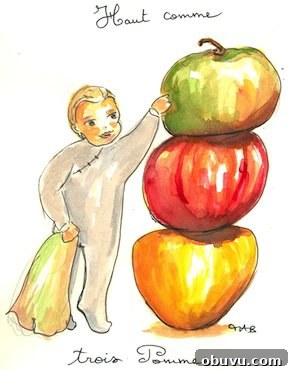
Illustration by MelinArt.
This article is part of a series on French idiomatic expressions related to food. Browse previous entries in the same series for more idioms and explanations.
This week’s expression is “Haut comme trois pommes.”
Literally translated as “as high as three apples,” the phrase describes someone—typically a child—who is small or very short. In English it’s often rendered with similar playful expressions such as “knee-high to a grasshopper,” though regional variations exist.
Example: “Il était haut comme trois pommes et devait courir pour rattraper ses soeurs.” (He was as high as three apples and had to run to catch up with his sisters.)
Listen to the idiom and example read aloud:
The expression dates from the early twentieth century. Its charm lies in its simple, concrete imagery: stack three apples and you immediately visualize a short stature. Apples of that era were often smaller than many modern varieties, so the comparison could imply quite a diminutive size. The phrase also carries an affectionate tone when applied to children—suggesting a small, adorable bundle that might topple any second—though it can sound patronizing when used for an adult.
Author Peyo used the expression to describe the Smurfs (les Schtroumpfs). In English translations of the comics, the phrase appears as “three apples high.” The idiom also figures in popular culture beyond comics: it opens the song that played over the closing credits of the Tom Sawyer animated series, a program that was especially popular with French children in the 1980s.
Because the expression is both visual and endearing, it remains a common way to remark on a child’s smallness in French conversation. It combines everyday imagery with a gentle tone, making it easy to picture and hard not to smile at when you hear it used.