Do you ever feel discouraged and ask yourself, “What should I weigh?” or “How much weight do I need to lose to be healthier?” This FAQ will help answer those questions.
At the start of a new year many of us set goals: lose weight, increase fitness, build muscle. Those are all worthwhile aims, but how do you make steady progress? A practical first step is understanding what a healthy weight looks like for you.
Determining an ideal weight is not one-size-fits-all. Decades ago the concept of “Ideal Body Weight” was developed to estimate an optimal weight for longevity based on height. While well-intentioned, that approach didn’t account for many individual factors—sex, ethnicity, medical history, body composition and genetics all influence what weight is healthiest for a person. For that reason, health professionals commonly use Body Mass Index (BMI) as a simple screening tool to estimate whether someone’s weight is in a typical healthy range for their height.
So what is your ideal weight?
Because many factors affect ideal weight, no single number fits everyone. BMI offers a useful starting point: it helps set a measurable, attainable target so you can plan realistic steps toward better health. Keep in mind BMI is an estimate, not a diagnostic measure, and should be considered alongside other indicators like fitness, muscle mass, blood pressure and metabolic markers.
What is BMI
Body Mass Index (BMI) estimates relative body fat using height and weight. It’s a convenient baseline to identify if you’re underweight, in a typical healthy range, or above it. Although BMI doesn’t directly measure body fat or distribution, it provides a quick reference that can guide goal-setting and conversations with healthcare professionals.
How to calculate your Body Mass Index (BMI)
To calculate BMI: divide your weight in kilograms by your height in meters squared. If you use pounds and inches, use the formula: (lbs / (inches²)) × 703 = BMI. To convert: pounds ÷ 2.2 = kilograms; inches × 0.0254 = meters.
(Kilogram / (Meters)2) = BMI or [(LBS / (Inches)2)] × 703 = BMI
For children and teens (ages 2–19), BMI is interpreted using growth charts that account for age and sex; this makes the calculation and the resulting interpretation age- and gender-specific.
What should my BMI be and how is it interpreted?
According to widely used public health guidelines, a typical adult BMI range considered healthy is 18.5–24.9. A BMI below 18.5 suggests underweight; a BMI above 24.9 indicates overweight or obesity. These ranges are general: they help identify potential risk but don’t replace a full health assessment. Athletes and people with higher muscle mass can have higher BMIs while still being healthy, and some people with BMIs in the “normal” range may have health issues that require attention.
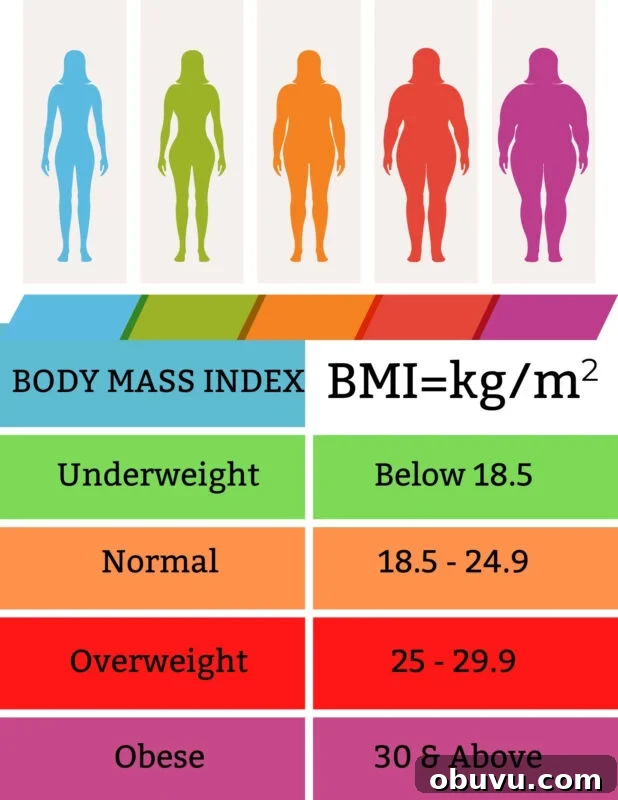
Use BMI as a starting point to understand where your weight falls and to set realistic goals. Pair it with other measures—waist circumference, body composition, fitness level and medical checks—to get a fuller picture of your health.
As you plan your goals this year, aim to make sustainable improvements rather than chasing a single number. Learn your current BMI, set measurable and achievable steps, and adjust based on how your body responds. Small, consistent changes often lead to the best long-term results.
Who’s ready to start the year with a practical, healthy plan?
You might also like
- 4 Portion Control Plates That Get Results
- 25 High Protein Foods I Eat the Most
- 42 Reasons You Overeat
Pin to save for later



-
 What I Eat In A Day for Weight Loss (5 Days at 1300-1500 Calories)
 -
7 Day Calorie Tracking Challenge {Data without Drama}
-
The Results of My100 Day Recomp, What I’ve Learned, and How I’m Moving Forward
-
It’s Not Willpower—It’s Procrastination That’s Sabotaging Your Weight Loss
-
My 150g of Protein Day {Build Muscle + Lose Fat!}
-
3 Habits For Effective Body Recomp with Optimal Results