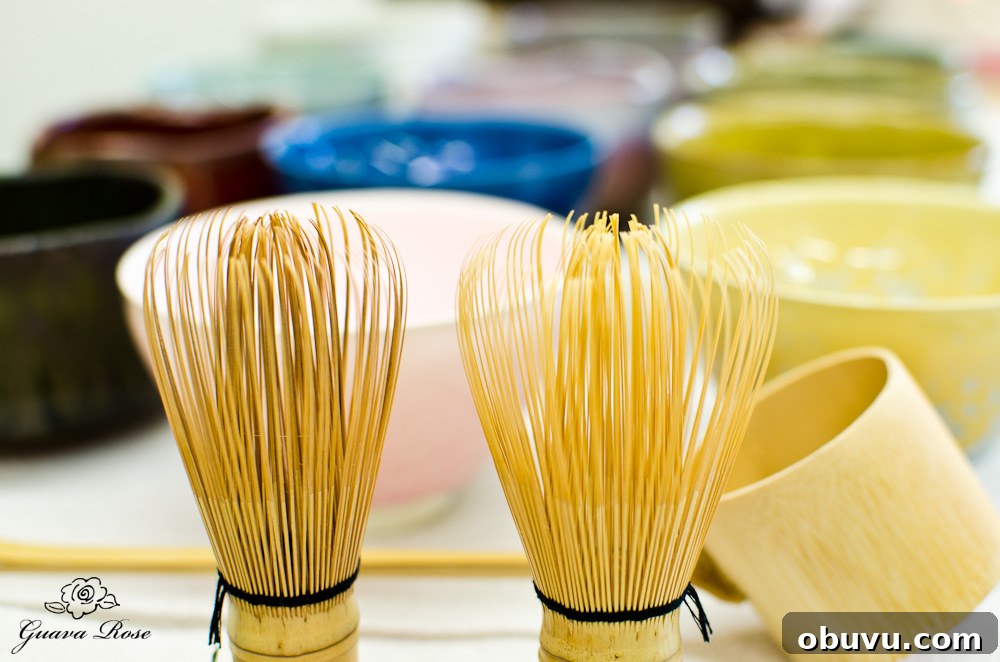
After the Japanese tea ceremony demonstration, the team began setting up for the students.
The women carefully unpacked supplies and arranged everything on the school desks, preparing each place for the upcoming lesson.
Tea bowls were kept and transported in wooden boxes to protect them between sessions.
Many tea bowls can be valuable, sometimes selling for high prices, though the bowls used for this demonstration were modest.
For newcomers, the matcha was prepared at half strength so everyone could enjoy the flavor comfortably.
Making matcha for a large group is time-consuming and requires attention to detail.
The same precision was applied when ladling hot water and whisking the matcha to achieve a smooth, frothy texture.
Once prepared, the bowls were placed on trays, ready for serving.
Before the tea, a sweet called manju was served to complement the bitterness of the matcha.
Each serving began with a respectful bow as the tea was presented to the students.
Students received clear instruction on proper etiquette, including how to rotate the bowl before drinking to avoid drinking from its front.
They expressed gratitude to the host with the phrase “Otemae o choudai itashimasu” before raising their bowls.
After thanking the host, each bowl was turned clockwise by two quarter turns so the drinker faced a plain section of the bowl.
The matcha was sipped—some participants enjoyed it with enthusiastic slurps, which in this context is a sign of appreciation.
After drinking, the bowls were rotated back counterclockwise by two quarter turns before being returned.
Participants took a moment to admire the craftsmanship and design of the tea bowls, appreciating both form and function.
Because only half the class could be served at once, the bowls were rinsed and dried between servings so the next group could partake.
In traditional practice, bowls are rinsed with hot water only—soap is not used.
Sohei Kagami
Mayumi received the name “Sohei” to recognize her advanced training in chanoyu, the way of tea.
Left to right: Sohei (Mayumi) Kagami, Kiyomi Buchanan (Sakura Gakuen Sensei), Mariko Sawada, and Etsuko Tsukano
Many thanks to these women for sharing their knowledge and inviting us to participate in a traditional Japanese tea ceremony—an experience that combined hospitality, ritual, and attention to detail.